
Grants & Projects per year
Personal profile
Biography
B.Sc., 1994, McGill University
A.M., 1996, Harvard University
Ph.D., 1999, Harvard University
Postdoctoral fellow, 1999-2000, Columbia University
Research interests
RESEARCH DESCRIPTION
I. Global Directions and Themes
My group’s research has primarily focused on two main areas (namely, nanotube chemistry and nanostructure synthesis) that will broaden the potential impact and practical applicability of nanostructures.
A. CARBON NANOTUBE (CNT) FUNCTIONALIZATION
In this area, we have reacted nanotubes as if there were chemical ligands (be it inorganic or organic) in their own right, e.g. as if these were simply complex alkenes. The work in our laboratory has been involved with understanding chemical reactivity involving carbon nanotubes from a structural and mechanistic perspective, which should hopefully expand the breadth and types of reactions CNTs can undergo in the solution phase. Specifically, the protocols that we have created have significantly enhanced the ability to purify, exfoliate, process, solubilize, and even render biocompatible CNTs, thereby permitting more facile photophysical, catalytic, and biomedical applications of these systems. Controllable chemical functionalization suggests that the unique optoelectronic and mechanical properties of SWNTs can be tailored in a determinable manner.
Key Case Studies of Successful Carbon Nanotube Functionalization in Inorganic, Organic, and Biological Systems
B. GREEN NANOSTRUCTURE SYNTHESIS
Early on, we expended a lot of effort on developing innovative syntheses of nanoscale formulations (including cubes, tubes, wires, spheres, and rhombohedra as well as aggregates and arrays) of perovskite oxide materials. More generally, we have implemented a number of viable environmentally friendly synthetic methodologies in the fabrication of a range of ternary and binary metal oxides, elemental metals, titanates, fluorides, phosphates, sulfides, tungstates, niobates, zirconates, ruthenates, and ferrites. In fact, most of our processes run under either ambient conditions or low temperatures, and can be efficiently scaled up. Moreover, our simple protocols are generally cost-effective; use mainly nontoxic precursors; limit the numbers of reagents and reaction steps; minimize waste, reagent use, and power consumption; and involve the development of high-yield processes with a relative absence of volatile and toxic byproducts.
In particular, we have made important advances in the use of molten-salt synthetic methods, hydrothermal protocols, and ambient template-directed techniques as green, cost-effective methodologies to generate monodisperse nanostructures with precise size and shape control without sacrificing on sample quality, purity, and crystallinity. Our as-prepared nanomaterials maintain fundamentally interesting size-dependent electronic, optical, and magnetic properties. In terms of applications, these nanostructures have wide-ranging utility in areas as diverse as catalysis, energy storage, biomedicine, computation, power generation, photonics, remediation, and sensing.
Key Case Studies of Successful Metal-Containing Nanostructure Synthesis
II. New and Emerging Trends
A. FUEL CELLS
Currently, Pt-based catalysts still represent the most widely used catalysts for applications in fuel cells due to their high activity. Nevertheless, we have initiated a number of efforts towards optimizing (1) the intrinsic particle size of Pt nanostructures, (2) the production of novel morphological motifs, such as either nanowires or three-dimensional nanostructures, as well as (3) the spatial distribution and dispersion of these nanoparticles to transcend the traditional view of elemental Pt itself as the most important and best performing fuel cell catalyst. This work exploring a range of alternatives to conventional catalysts and support media is summarized in a number of invited contributions including ACS Applied Materials and Interfaces, v.13, 58253 (2021); Chem. Eur. J., v.25, 7779 (2019); ACS Omega, v.3, 3294 (2018); APL Materials, v.3, 080701 (2015); Chem. Soc. Rev., v.44, 5836 (2015); J. Phys. Chem. Lett., v.3, 3385 (2012); and Energy & Environmental Sciences,v.4, 1161 (2011). The scope of the novelty of our contributions is covered by issued U.S. patents #9,440,290 B2; #9,490,486; #9,624,598; and #9,623,481. As an example, some of the highest electrochemical activities reported to date have been obtained by deliberately tuning the size, morphology, and chemical compositions of Pt-based alloyed nanostructures. In so doing, activities of over a magnitude higher than the state-of-the-art commercial Pt catalyst have been achieved.
We and other groups have explored a number of nanowire-based catalytic architectures, composed of Pt-free or reduced Pt content, as an energy efficient solution with improved performance metrics versus conventional, currently commercially available Pt nanoparticles that are already well known in the community. Our goal therefore has been to precisely, synergistically, and simultaneously tune size, morphology, architectural motif, surface chemistry, and chemical composition of generated catalysts coupled with the nature of the underlying support so as to controllably improve performance metrics of the hydrogen oxygen reaction (HOR), the methanol oxidation reaction (MOR), the ethanol oxidation reaction (EOR), the formic acid oxidation reaction (FAOR), in addition to the oxygen reduction reaction (ORR). As such, we have developed ambient synthetic methods to prepare morphology and composition-tunable, crystalline one-dimensional nanostructures possessing reproducible structural uniformity and a homogeneous distribution of elements on a large and sustainable scale. These advances are of relevance for creating a cheaper, more durable, more efficient, high-performing, and distinctive family of catalytic materials that will also be inherently less susceptible to poisoning and degradation.
B. SOLAR CELLS
The ability to synthesize, functionalize, and purify nanomaterials and to understand their transport, optical and mechanical properties lies at the forefront of current materials science research. Nanostructured materials offer several potential advantages for solar energy conversion by providing relatively high electron and hole transport efficiencies, excitation multiplication possibilities, high surface-to-volume ratios, and short electron-hole diffusion lengths to junctions. However, the role of nanoscale heterojunctions in promoting exciton dissociation and charge separation is not understood. It is expected that junctions between low dimensional materials will behave differently as compared with bulk junctions. We addressed the important question of the efficiency of charge separation versus recombination or trapping in a prototype heterogeneous nanomaterial system, i.e. 0d-1d nanomaterial hybrids. We also developed a fundamental emphasis on synthesizing and understanding more complex nanoscale materials, including metallic heterostructures, of significance to the solar initiative. We had the ability to synthesize high quality samples and to study the properties and structure (both electronic and physical) of individual nanomaterial samples, thus eliminating the uncertainties in ensemble averaging over many structures. Along with theory, these studies clarified the potential of nanoscale heterojunctions for charge separation in solar electric generation. Our activities have been summarized in a number of papers including Energy & Environmental Sciences, v.12, 1454 (2019) and Chem. Soc. Rev., v.42, 8134 (2013).
C. BATTERY-RELATED APPLICATIONS
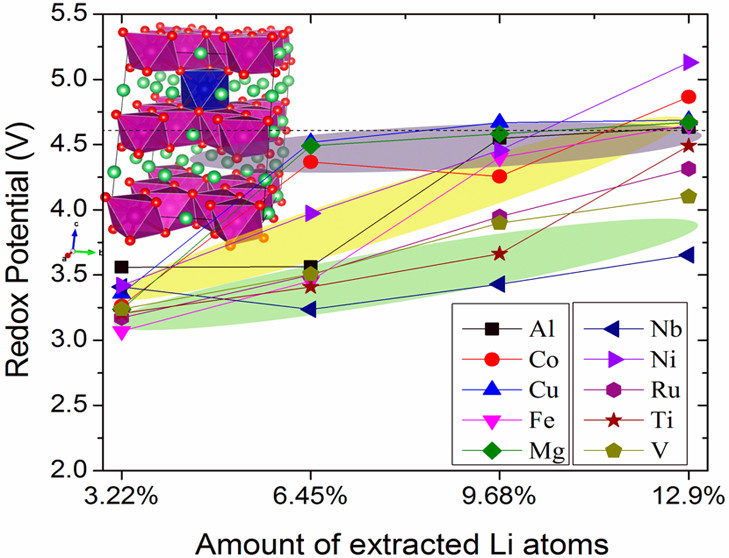
In a parallel effort (ACS Energy Letters, v.2, 1465 (2017) and Nanomaterials, v.13, 1599 (2023)), we have noted that metal oxides and sulfides represent a set of promising materials for use as electrodes within lithium ion batteries but unfortunately, these tend to suffer from limitations associated with poor ionic and electron conductivity as well as low cycling performance. Hence, to achieve the goal of creating economical, relatively less toxic, thermally stable, and simultaneously high-energy-density electrode materials, we have put forth and analyzed a number of targeted strategies, aimed at rationally improving upon electrochemical performance. Specifically, we have carefully studied the precise roles and effects of controllably varying not only (i) morphology but also (ii) chemistry as a means of advancing, ameliorating, and fundamentally tuning the development and evolution of systems such as FeS2, Fe3S4, Fe3O4, Li4Ti5O12, TiO2, and LiV3O8 as viable and ubiquitous energy storage materials.
D. NUANCES OF NANOMATERIAL TOXICOLOGY
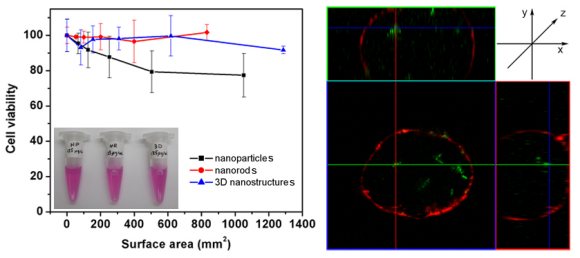
The use of any material for practical applications engenders risk. Frankly, even water itself can be fatal if misused. What is important is in understanding what constitutes acceptable risk. For nanomaterials, the key point is in determining whether a substance is inherently toxic and under what specific circumstances, it can be particularly harmful. In both cellular and marine studies, our group has found that the toxicity of a nanomaterial is often a function not only of its actual chemical composition but also of its particular structural morphology.
Nanostructures for Biological Labeling
Fingerprint
Dive into the research topics where Stanislaus S. Wong is active. These topic labels come from the works of this person. Together they form a unique fingerprint.
- 1 Similar Profiles
Collaborations and top research areas from the last five years
Recent external collaboration on country/territory level. Dive into details by clicking on the dots or
-
Graduate Student Support for Tudor Muntean: Microstructural studies of battery materials
Wong, S. S. (PI)
12/23/25 → 12/31/26
Project: Research
-
Correlating the Synthesis and Electrochemical Performance of Complex Multi-Element High Entropy Oxides
Fang, J., Millares, M. F., Mansley, Z. R., Rodriguez Campos, A., Barry, P. J., Luo, J., Raji, A., Hill, R. C., Pace, A., Dahal, B., Oravez, M., Morelli, L., Chen, L. Y., Ma, L., Yang, D., Zhong, H., Bai, J., Takeuchi, E. S., Marschilok, A. C. & Zhu, Y. & 3 others, , Feb 18 2026, In: ACS Applied Materials and Interfaces. 18, 6, p. 9655-9669 15 p.Research output: Contribution to journal › Article › peer-review
1 Scopus citations -
Evaluating Ru-RuO2@BN as a Bifunctional Electrocatalyst for the Nitrogen Reduction Reaction and the Hydrogen Evolution Reaction
Sharma, M., Sotsky, L., Park, S., Sasaki, K., Frenkel, A. I., Halada, G. & Wong, S. S., Mar 9 2026, In: ACS Applied Energy Materials. 9, 5, p. 2709-2721 13 p.Research output: Contribution to journal › Article › peer-review
3 Scopus citations -
Synthesis and Evaluation of Cu@ZnO Core@Shell Nanowires for Use in the Carbon Dioxide Thermal Reduction Reaction
Gallagher, M. G., Wang, Y., Chen, X., Carnahan, D. M., Zou, L., Garcia, J. M., Avila, E. E., Yang, D., Barba-Nieto, I., Prabhakar Reddy, K., Zhou, G., Rodriguez, J. A. & Wong, S. S., Jul 9 2026, In: Journal of Physical Chemistry C. 130, 27, p. 9316-9330 15 p.Binghamton University, Stony Brook University
Research output: Contribution to journal › Article › peer-review
-
2024 Energy and Fuels Community Highlights: Advancing Materials and Technologies in Decarbonization and Renewable Energy Solutions
Song, C., Wong, S. S., Cheng, Y., Gurkan, B., Hu, Y. H., Chaffee, A., Zhang, S., Hu, L., Bashir, S. & Liu, J. L., Sep 12 2025, In: ACS Energy Letters. 10, 9, p. 4543-4552 10 p.Research output: Contribution to journal › Comment/debate
Open Access12 Scopus citations -
Identifying the Role of Magnesium Content in Assessing the Electrochemical Performance of (CoCuMgNiZn)O
Fang, J., Millares, M. F., Mansley, Z. R., Luo, J., Wang, Z., Huang, C., Barry, P. J., Hill, R. C., Pace, A., Garcia, J., Morelli, L., Ma, L., Yang, D., Tayal, A., Bai, J., Tong, X., Takeuchi, E., Marschilok, A. C., Zhu, Y. & Yan, S. & 2 others, , Aug 19 2025, In: ACS Nano. 19, 32, p. 29122-29140 19 p.Research output: Contribution to journal › Article › peer-review
4 Scopus citations